
Our venerable film projector is back as cinema returns to its roots for The Odyssey
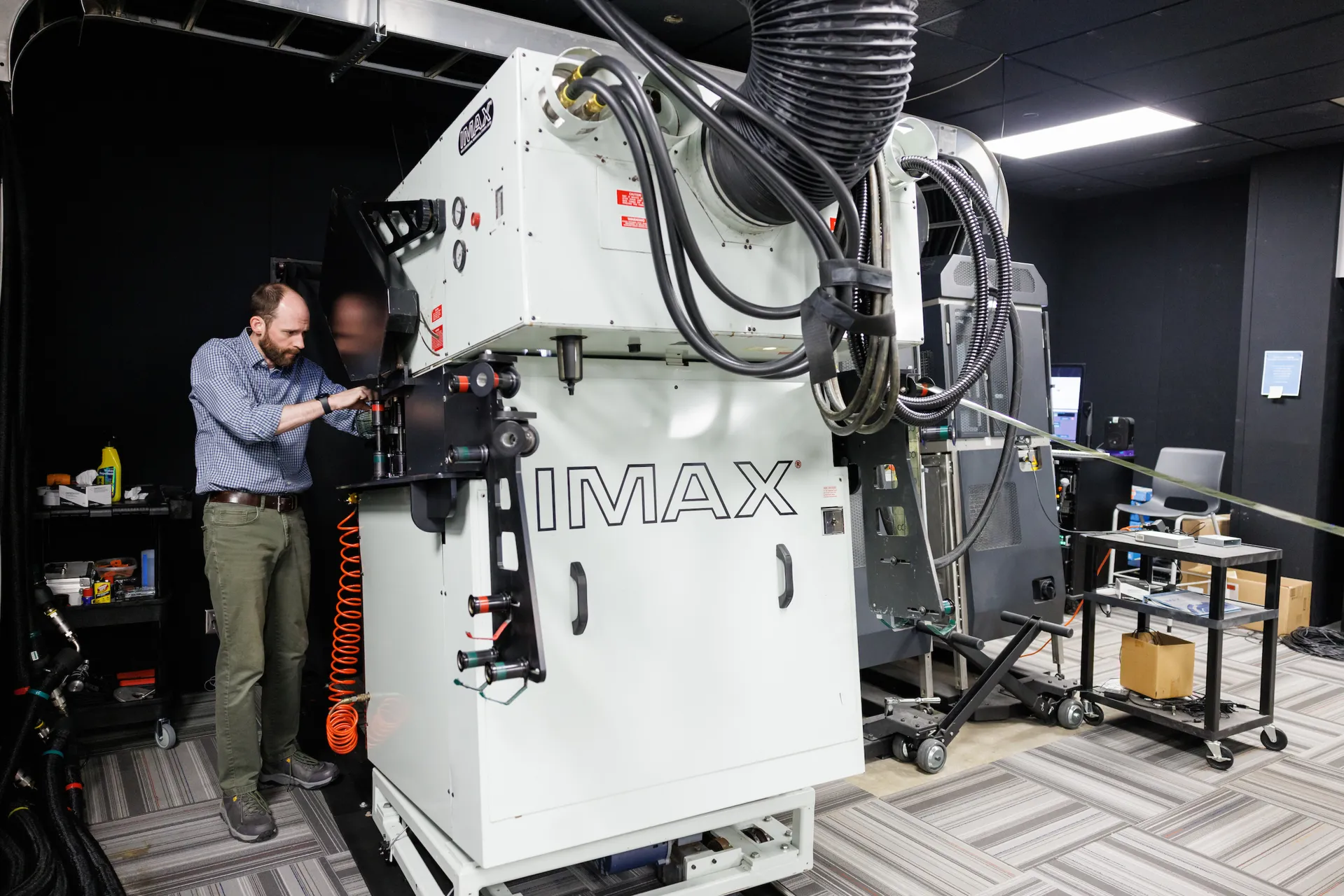
Like Odysseus’s triumphal return after years away from his homeland, the Tennessee Aquarium is celebrating three decades as a destination for giant-screen movie fans by bringing back the format that put it — and Chattanooga — on the cinematic map.
In 2016, the Aquarium retired its workhorse 70mm GT (Grand Theatre) film projector as part of a $1.6 million upgrade to a state-of-the-art IMAX with Laser digital projection system. After presenting tens of thousands of screenings that established the IMAX 3D Theater as a must-visit destination for large-format 3D cinema, the technological leapfrog to the cutting-edge of digital cinema seemed destined to put film firmly in the rearview mirror.
Yet even as the upgrade was taking place, then-chief projectionist Corey Cobb couldn’t help but feel a lingering attachment to the stately GT film projector he’d operated for so many years. In fact, it was only a nostalgic pang on Cobb’s part that prevented this once-vital equipment from quite literally getting the axe during the digital upgrade.
“They were considering cutting the projector in half to try to get it in the elevator and out of the building,” recalls Cobb, now the Aquarium’s director of IMAX operations. “I intervened and said, ‘No, absolutely not.’
“It’s a beautiful piece of equipment. I thought, down the road, this might be something that ends up in the lobby or — if nothing else — stays up here so we can bring people up to see the old versus the new.”
The 70mm GT was given a stay of execution and relocated to an unused corner of the projection booth where it quietly gathered dust for years.
Film fanatics
Despite the cinema industry’s overall shift to digital, film continued to have its evangelists, including directors like Quentin Tarantino, Ryan Coogler and, above all others, Christopher Nolan. In 2023, Nolan made waves when he recorded his masterwork on the birth of the Atomic Age, Oppenheimer, using only film — albeit only a quarter of it using the largest, 70mm format. Purists went to great lengths to see Oppenheimer at the few remaining facilities that were still capable of film projection.
Then, Nolan did something truly unprecedented. In 2025, he recorded his latest opus, The Odyssey, on IMAX 70mm.
Not just select scenes — all 172 minutes of it.
When it releases this Thursday, July 16, Nolan’s star-studded reimagining of the Homeric epic will be shown at thousands of digital-only theaters. To cinephiles the world over (including its auteur director), however, it will only be viewable in its purest form when projected via IMAX 70mm film onto the proper screen.
Across the globe, fewer than 50 theaters can display The Odyssey as Nolan intended. Thanks to Cobb’s timely sentimentality, the Tennessee Aquarium IMAX 3D Theater is one of them.
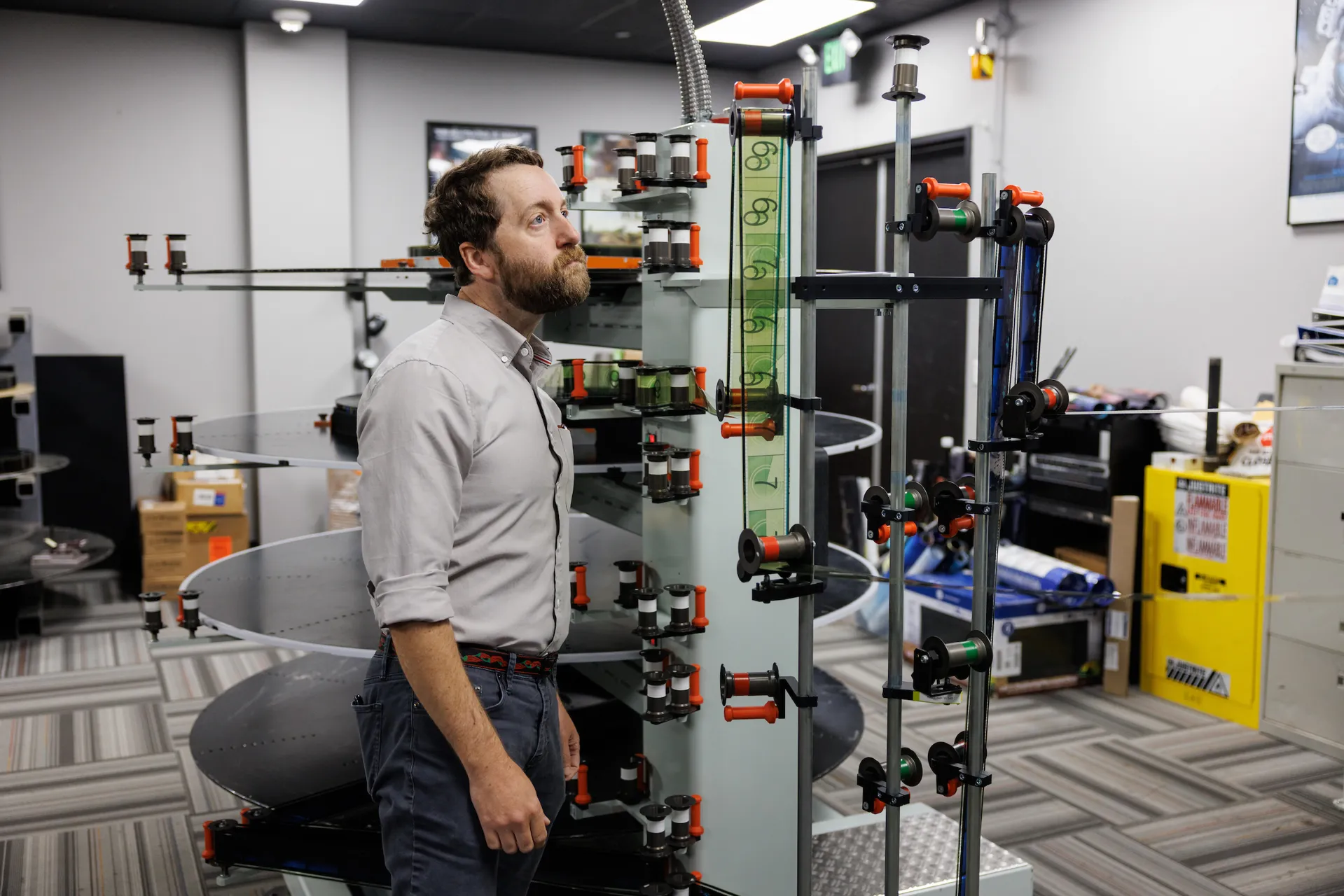
Hearing it start back up for the first time in a decade, seeing all those little things that make film special —that was where it really hit. I never in a million years could have imagined that we’d be running films in that booth again.
Corey Cobb
Director of IMAX Operations
Out of retirement
Last year, the IMAX Corporation sought to capitalize on the buzz surrounding Nolan’s unprecedented return to a format many thought well past its expiration date. IMAX’s then-Chief Quality Officer David Keighley — who passed away last September — began reaching out to theaters trying to learn which still possessed the equipment and expertise necessary to present The Odyssey on film.
“I think IMAX had promised him (Nolan) a certain number of theaters for The Odyssey,” Cobb says. “Since we had a film projector, we were on that short list of potential theaters that could reinstall.”
Last year, IMAX engineers worked with the Aquarium’s facilities team to un-retire the 70mm GT film projector and get it ready for the debut of Nolan’s epic. Properly re-throned, the film projector once again sits alongside the IMAX with Laser GT digital projector above the Aquarium’s 345-capacity theater.
According to official IMAX availability, the Tennessee Aquarium IMAX Theater is one of just 25 theaters in the United States and 41 worldwide that will be showing The Odyssey on true IMAX 70mm. Even fewer of those can claim to have IMAX’s flagship digital and film projectors installed simultaneously.
“The number gets real small when you look at us from the perspective of having the greatest film projector and the greatest digital projector that IMAX has ever created,” Cobb says. “If you’re an IMAX fanboy, we’re one of maybe five in the United States that has the capability to do both.”
The difference
But why does any of this matter?
Unless you’re watching The Odyssey somewhere like the Tennessee Aquarium IMAX 3D Theater, you’re literally missing the picture — about 40% of it.
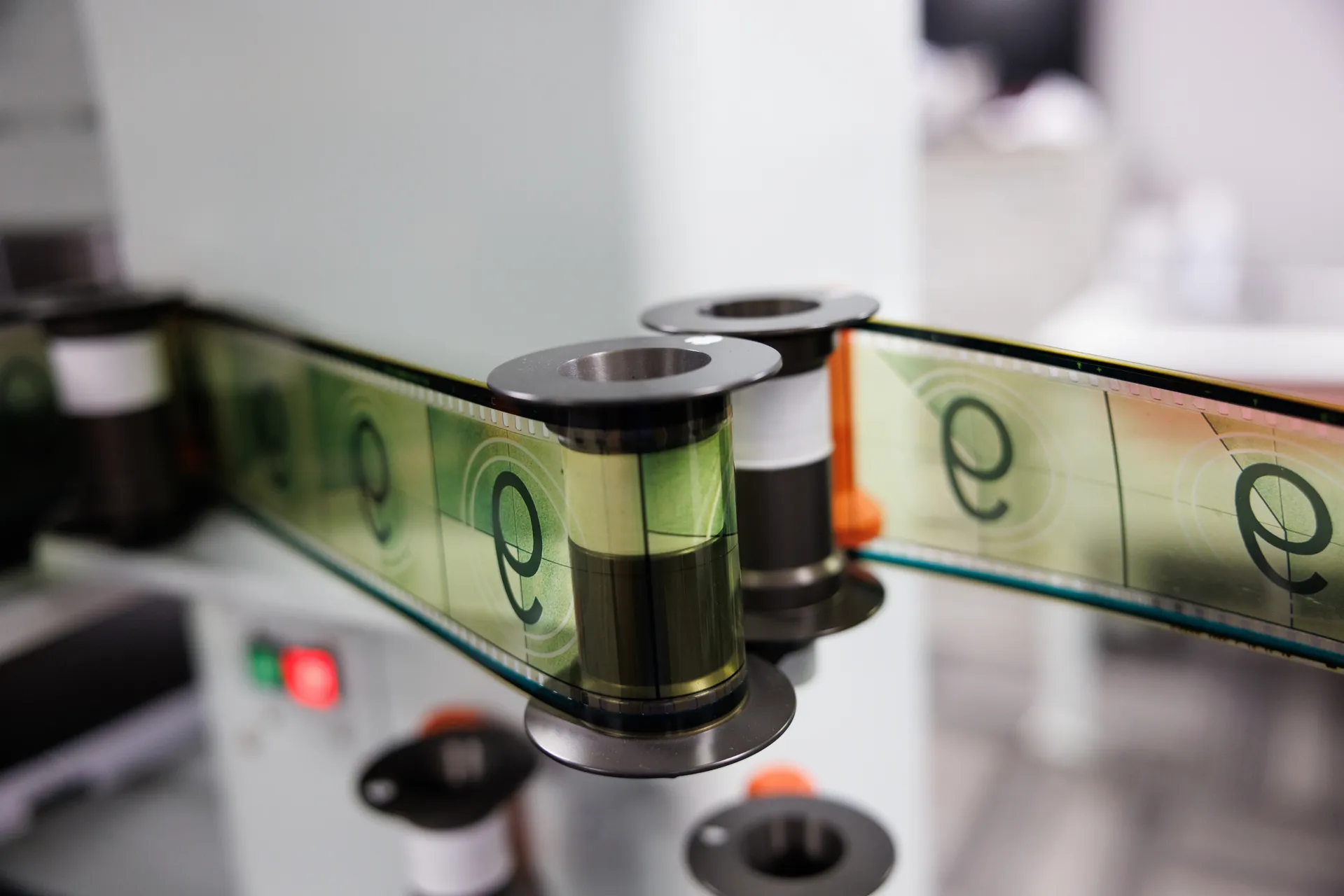
When it comes to film formats, size does matter, and 70mm film is significantly larger than standard 35mm. To analogize it, the size difference is about the same as a postage stamp (35mm) compared to a large smartphone screen (70mm).
Many cinematographers and directors say the appeal of this format, beyond the increased real estate, is the a more “organic” recreation of light and a higher equivalent resolution when compared to digital footage.
“That (70mm film) is the highest-quality imaging format that’s ever been devised,” Nolan told 60 Minutes correspondent Scott Pelley. “There’s nothing that competes with it.
“It’s a massive negative. … When correctly exposed, correctly printed and projected onto a huge screen, there’s an image quality there that you can’t get anywhere else — incredible sharpness, very little visible grain.”
Capturing a larger image doesn’t yield better results without a screen that can take full advantage of it, though. Some of the extra imagery recorded on large-format film cameras is lost on a standard cinema screen due to zooming in (cropping) the larger image to fit.
At 66 feet tall by 89 feet wide, however, the Tennessee Aquarium IMAX 3D Theater’s screen dimensions align with IMAX’s “gold standard” 1.43:1 aspect ratio. This taller configuration can properly display the entire 70mm film image, offering greater immersion by filling more of the audience’s field of view. Put simply, The Odyssey, already a mammoth story, will seem even bigger on a screen like the Aquarium’s.

This theater was something new. Most people in the region had not been to an IMAX theater, and they had never seen anything in 3D.
Gordon Stalans
Chief Operating Officer
A cutting-edge history
The Odyssey and the return to film continue the IMAX 3D Theater’s history of setting the pace for large-screen cinema in the Southeast.
From its premiere showing on May 4, 1996, the IMAX 3D Theater represented the first major expansion to the Tennessee Aquarium’s downtown campus since it opened four years earlier. At the time, the $14 million investment ($36 million, adjusted for inflation) was a strategic decision by the Aquarium to capitalize on the notoriety of being an early adopter of an emerging technology.
Worldwide, opportunities to see large-format 3D films were incredibly rare. Only 14 facilities across the globe — eight of them in the U.S. — could show 3D imagery at the time. The next-closest 3D facility to Chattanooga was 450 miles away in New Orleans, says Chief Operating Officer Gordon Stalans.
“This theater was something new. Most people in the region had not been to an IMAX theater, and they had never seen anything in 3D,” Stalans says. “During showings, you’d see not only children but also adults reaching out trying to touch something on screen.”
The IMAX 3D Theater was a tremendous success out the gate, attracting 700,000 guests in its first year of operation, despite only showing a single film, Into the Deep, for the first six months.
For years, the IMAX 3D Theater primarily screened shorter-length science and nature films and had limited access to first-run Hollywood features. That changed in the wake of the global pandemic, when studios began making blockbusters such as Oppenheimer and Dune available. This influx of mainstream content helped the IMAX 3D Theater establish a reputation as a premiere venue among cinephiles.

The Odyssey begins
The rarified air in which the IMAX 3D Theater now finds itself as a travel-worthy destination is clear in the national reach of its advance ticket sales to The Odyssey. Since presales began on June 4, more than 2,500 tickets have been sold to guests in 23 states, including some from as far away as Montana, Washington, California and Arizona.
The frenzy of excitement surrounding The Odyssey’s arrival speaks as much to the resurgence of film as it does the IMAX 3D Theater’s reputation, Cobb says.
“Odyssey is bringing back a technology that we used to use, but there are only 40 odd theaters showing IMAX film product worldwide, so it’s a unique experience we can give people,” he says. “I’ve talked to so many locals that are here all the time, and they’re like, ‘I’m so glad y’all put the film projector back in. Now I don’t have to drive to Atlanta or Nashville.”
Advance tickets are on sale now for The Odyssey, which will begin screening on IMAX 70mm film at the IMAX 3D Theater on Thursday, July 16 at 5 p.m. To check showtimes and purchase tickets, visit tnaqua.org/odyssey