Tribute authored by Tennessee Aquarium Board Member, Eric Meyers.
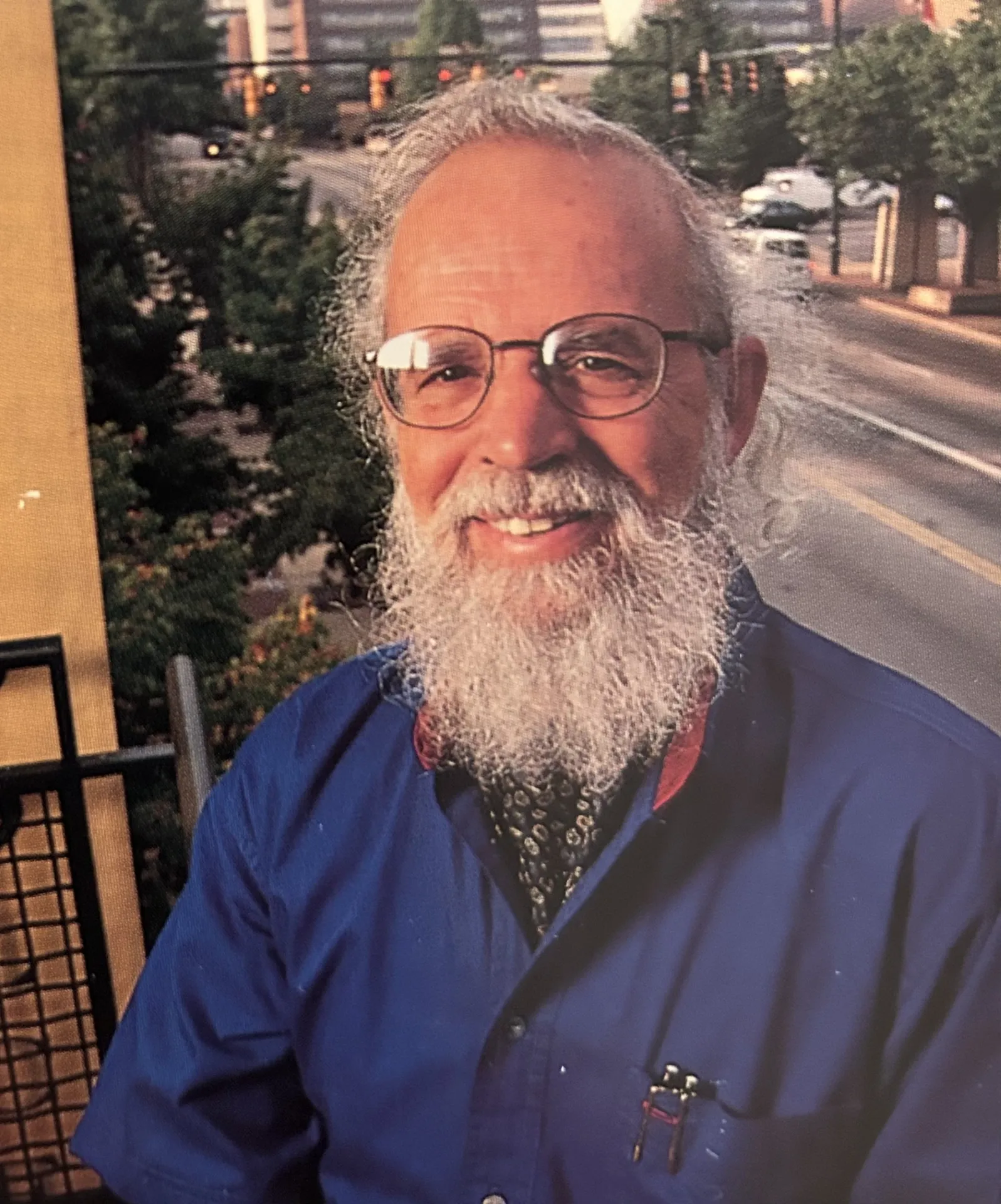
We at the Tennessee Aquarium mourn the passing of a true visionary whose work helped reconnect Chattanooga to its river. Stroud Watson—professor, urban designer, husband, and father—had a profound influence on downtown Chattanooga from the early 1980s through today. He passed away on March 13, 2026, leaving behind a legacy of transformative places deeply intertwined with the Aquarium’s origin story.
In 1986, an exhibit titled “Images of Chattanooga – Centre City and River Edge” was displayed in an abandoned storefront in the heart of downtown. Led by Stroud Watson and his students from the Urban Design Consultancy and the University of Tennessee School of Architecture and Design, the exhibit presented visionary scenarios for the future of Chattanooga’s riverfront. At the time, the riverfront was largely inactive, dominated by vacant industrial sites and cut off from downtown by a four-lane highway. These speculative designs, unconstrained by budgets or timelines, invited the community to imagine what could be possible. The ideas sparked by Stroud and his students ignited a transformation that would become internationally recognized and enjoyed by millions each year.
For several years, that same storefront evolved into a collaborative hub that frequently brought together elected leaders and organizations such as Chattanooga Venture, the Chattanooga-Hamilton County Regional Planning Agency, the Chattanooga Downtown Alliance, Partners for Economic Progress, and the River City Company. The Urban Design Consultancy operated the shared space, fostered coordination and helped build momentum toward a unified vision for the city’s future.
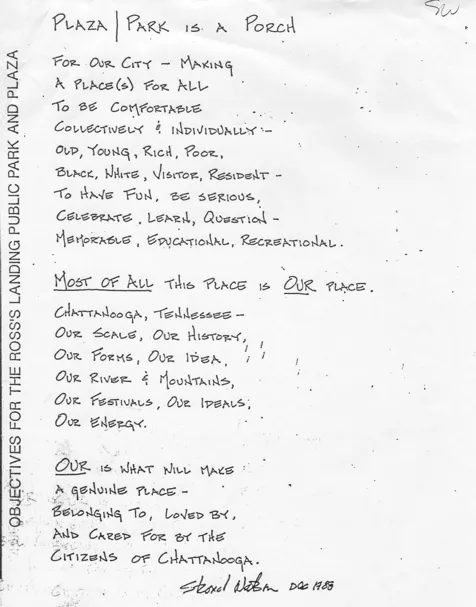
In 1988, the Urban Design Consultancy was commissioned by the River City Company and guided by the Ross’s Landing Design Committee, to begin planning the city block surrounding a new freshwater aquarium. Stroud carefully assembled a diverse, high-caliber design team that included landscape architecture firm, EDAW, SITE (James Wines), Hensley-Schmidt Engineers, Robert Seals Architects, and artists John Mackie and Stan Townsend. Stroud’s clearly articulated “Objectives for the Ross’s Landing Park and Plaza,” published in 1988, shaped every aspect of the design.
The resulting conceptual plan, formally published in 1989, reimagined the relationship between the city and the river. It proposed a public plaza that would “erode” the city grid toward the water, incorporating features such as a meandering stream reconnecting to the river and “lifted landscapes” offering shade, texture, and views of both downtown and the waterfront. While some elements have evolved over time, the design’s core intent—to create a dynamic, welcoming civic space—remains intact.
A frequently asked question is why the Aquarium is not centered along Broad Street. This decision reflects Stroud’s guiding philosophy: architecture should respond to its natural context. The Aquarium’s placement emphasizes views of Chattanooga’s surrounding ridges and valleys beyond, reinforcing the unique geography of the Tennessee River corridor. This sensitivity to place continues to inform the Aquarium’s conservation mission today.
As the Ross’s Landing Park and Plaza project approached construction, Stroud’s consultancy expanded into the Riverfront/Downtown Planning and Design Center, playing a key role in shaping the evolving riverfront district. In the following years, the CARTA Shuttle Park North opened in 1994 including a new downtown movie theater, adding evening activity to the area. In 1995, the Creative Discovery Museum debuted, with Stroud’s team collaborating closely on its design, including its distinctive glass frontage and entry plaza oriented to “gather the energy” of the riverfront district.
That same spirit of innovation guided the Tennessee Aquarium IMAX Theater design competition, an international effort led by Stroud and the Design Center in 1994. The selected design further strengthened the district as a cultural destination.
In 2001, Stroud and his team were instrumental in the 21st Century Waterfront initiative, a comprehensive effort to complete Chattanooga’s “return to the river.” This transformative effort enhanced public spaces, expanded key attractions, and strengthened connections between districts, ensuring the waterfront would serve as a vibrant, accessible place for all.
Today, the Tennessee Aquarium remains deeply grateful for Stroud Watson’s vision and leadership. His work reminds us of the importance of connecting people to place—and how thoughtful design and investing in high-quality public spaces can enrich entire communities. From the River Market to the Passage to the waterfront parks, his influence continues to shape experiences and create memories enjoyed by residents and visitors alike.