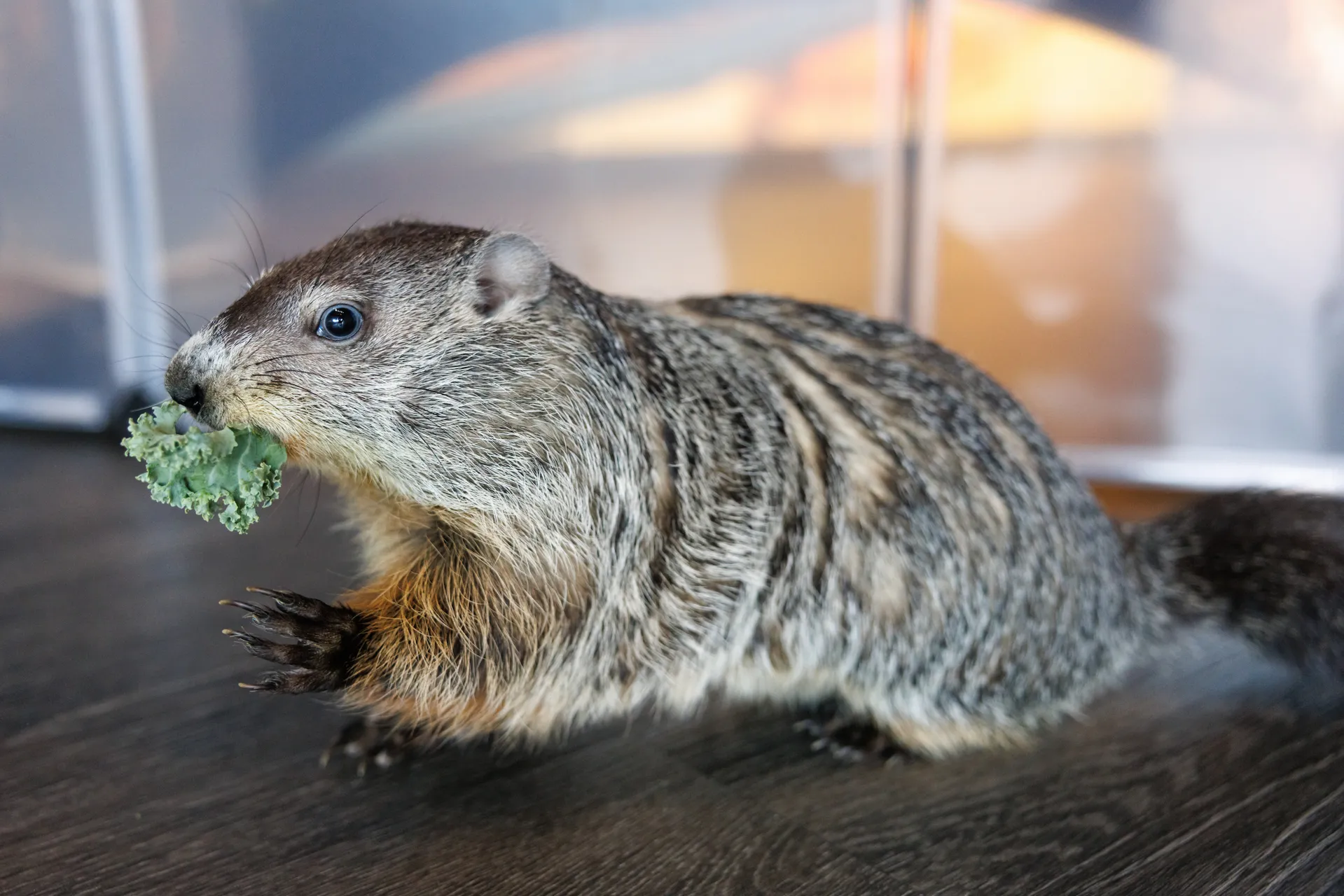
Chattanooga, Tenn. (Sept. 22, 2026) – A young weathercaster-in-the-making made his debut at the Tennessee Aquarium on Tuesday, but unlike typical meteorologists, the only predictive tool this furry prognosticator relies on is his shadow.
About seven years after the passing of the Aquarium’s beloved groundhog, Chattanooga Chuck, his successor — dubbed “Chattanooga Chuck II” in memoriam — has joined the ranks of its ambassador animal program. Alongside Aquarium educators, he will take part in programs to teach guests about this ubiquitous, but often unnoticed, native mammal.
And, of course, to put his weather-predicting skills to use.
“Chattanooga Chuck II” — named Waddles by his caretakers — arrived as a young Groundhog at the Lookout Mountain-based private veterinary clinic of Aquarium Director of Animal Health Dr. Chris Keller. There, he received treatment for a leg broken after being struck by a car. The fracture from that injury left him with a potential lifetime of challenges to overcome.
“Groundhogs are extremely reliant on their forelegs for digging burrows,” Dr. Keller says. “Though his broken leg has healed well, we were concerned about him developing issues related to his injury that could impact his ability to thrive if he were released into the wild.”
Instead, the Aquarium took the juvenile ‘hog into its care. In his new home in the River Journey building, skilled husbandry and veterinary teams have the experience needed to meet “Chuck’s” needs and ensure his well-being while he helps foster a greater sense of connection to between guests and native wildlife.
Passing on the title of “Chattanooga Chuck” is akin to the naming conventions of notable collegiate football programs. Fans of the University of Tennessee at Knoxville and the University of Georgia have known and loved generations of canine mascots who bore the name “Smokey” and “Uga.”
Now, a new “Chuck” will carry on the legacy of a Groundhog that captivated Chattanoogans — and the rest of the country — with his forecasting-by-shadow every Feb. 2.
The original “Chattanooga Chuck” made his first Groundhog Day forecast at the Aquarium in 2010. He went paw-to-paw against other notable weather groundhogs like Punxsutawney Phil with predictions that were broadcast nationwide. The Weather Channel even included him on its list of “Top Groundhogs to Watch.”
In November 2019, Chuck passed away in his sleep at age 10, leaving the Aquarium without a weather-watching whistle pig for nearly seven years. “Chuck II” will carry on his namesake’s legacy while also drawing attention to other, lesser-known Aquarium residents, says Thom Benson, the Aquarium’s vice president and chief marketing and communications officer.
“Having an ambassador like ‘Chattanooga Chuck’ allows the Aquarium’s team to introduce guests to a charismatic native species throughout the year,” says Benson, who spent more than a decade as an on-air meteorologist in Chattanooga before joining the Aquarium’s ranks.
“But there’s a lot of fascinating weather folklore associated with a variety of species from fish to birds, and even reptiles and amphibians,” he adds. “That makes Groundhog Day special here as we’re able to shine a light on animals with fun, forecasting lore that the Groundhog’s fame has overshadowed.”
“Chuck’s” caregivers are working hard to prepare him for that role — and his first Groundhog Day appearance in February — through voluntary training and positive reinforcement to ensure he thrives in his future interactions with the public.
“He is very outgoing, curious and food-motivated,” says Senior Animal Care Specialist Tyler Schneider. “He is adventurous and will act timid at first with strangers, but he quickly comes out of his shell when food is involved. Carrots, broccoli and cashews are some of his favorites.”
Groundhog facts:
- Groundhogs (Marmota monax) are one of only a few native mammal species that enter true hibernation, during which their body temperature drops and their heart rate and breathing slow dramatically for the majority of winter.
- Groundhogs are mostly solitary by nature, and interactions among individuals are typically limited to mating season.
- Groundhogs are herbivorous rodents with four large incisors that they use for chewing. Their strong legs are adapted for digging extensive burrows, which they use for protection, rearing offspring and hibernating.