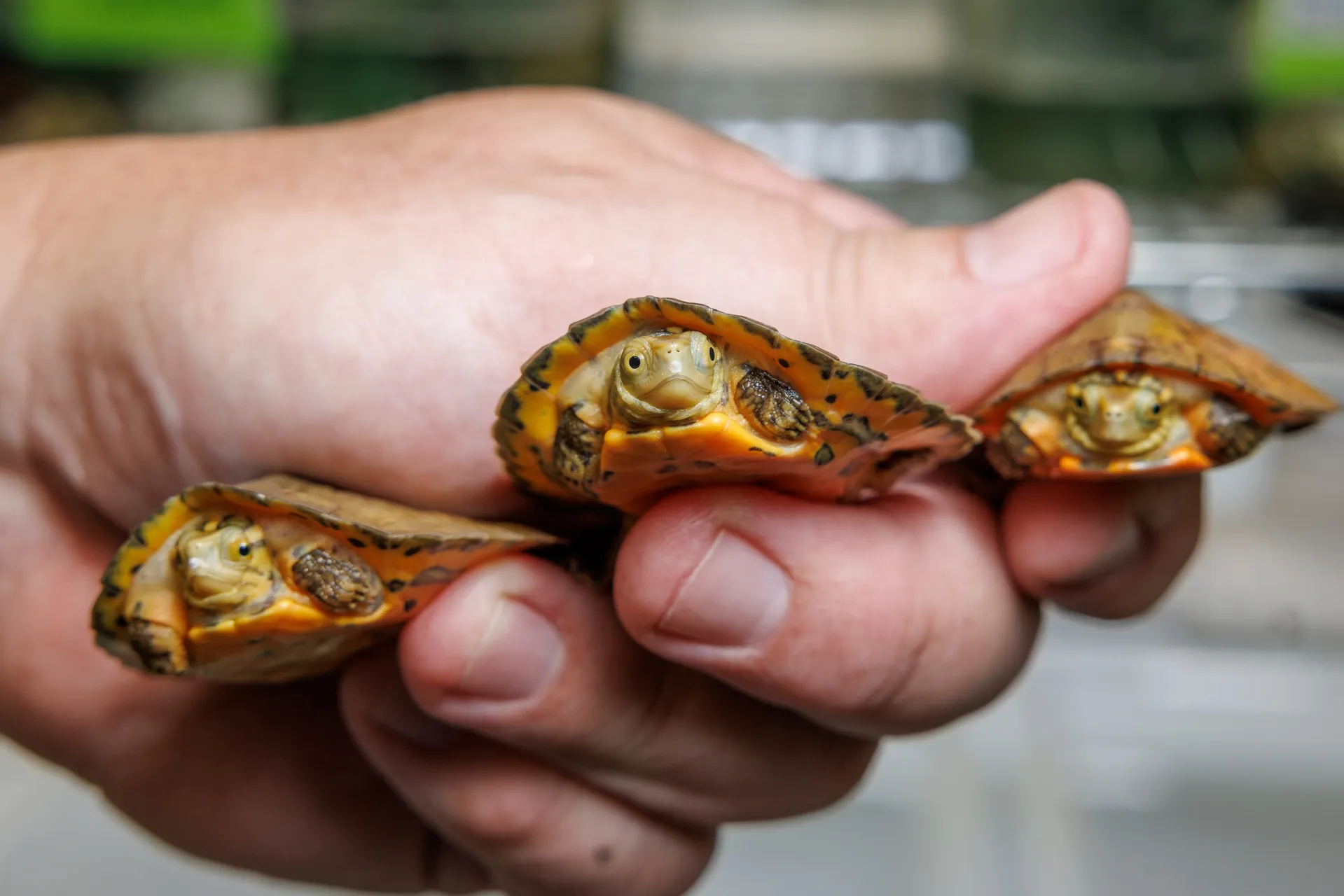
Chattanooga, Tenn. (July 7, 2026) – North America’s largest publicly viewable collection of freshwater turtles is a little bit bigger and even more adorable thanks to a baby boom at the Tennessee Aquarium that hatched seven new turtles since mid-May.
Many of these tiny reptiles represent important additions to species classified as endangered or critically endangered by the International Union for Conservation of Nature. The wave of springtime hatchings included a trio of Four-eyed Turtles (critically endangered), a Beal’s Four-eyed Turtle (endangered), a Spotted Turtle (endangered), a Ringed Map Turtle (endangered) and a Hilaire’s Side-necked Turtle (unlisted).
Even more turtles are on the cusp of hatching, including another pair of Ringed Map Turtles — a species the Aquarium last hatched in 1998 — and clutches of eggs laid by Central American Wood Turtles (near-threatened) and Yellow-blotched Map Turtles (vulnerable). These eggs are now in incubators, where they are exhibiting healthy development.
Only a herpetologist with more than three decades of experience breeding and raising turtles could classify the arrival of so many babies and eggs in such a short time as “a slow year.”
“This is the time of year when we get most of our turtle hatchings, but we haven’t had quantities of anything this year,” says Herpetology Collection Coordinator Bill Hughes. “But we didn’t really want to hatch a lot this year, so three Four-eyed Turtles is actually a good number.”
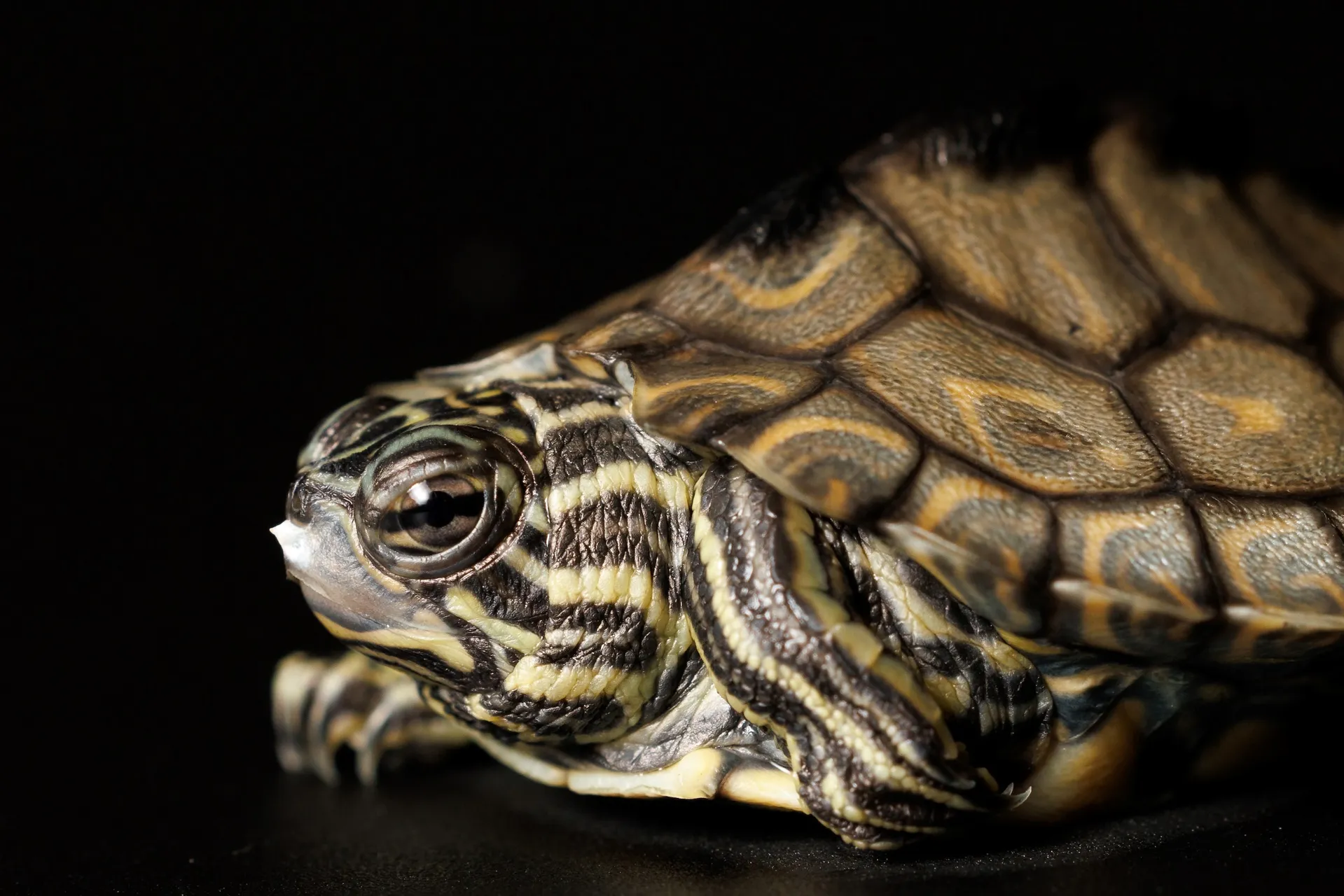
Now entering his 22nd year at the Aquarium, Hughes set an early, high bar for success caring for baby turtles. In 2007, he made national headlines by hatching the first Four-eyed Turtle ever in human care.
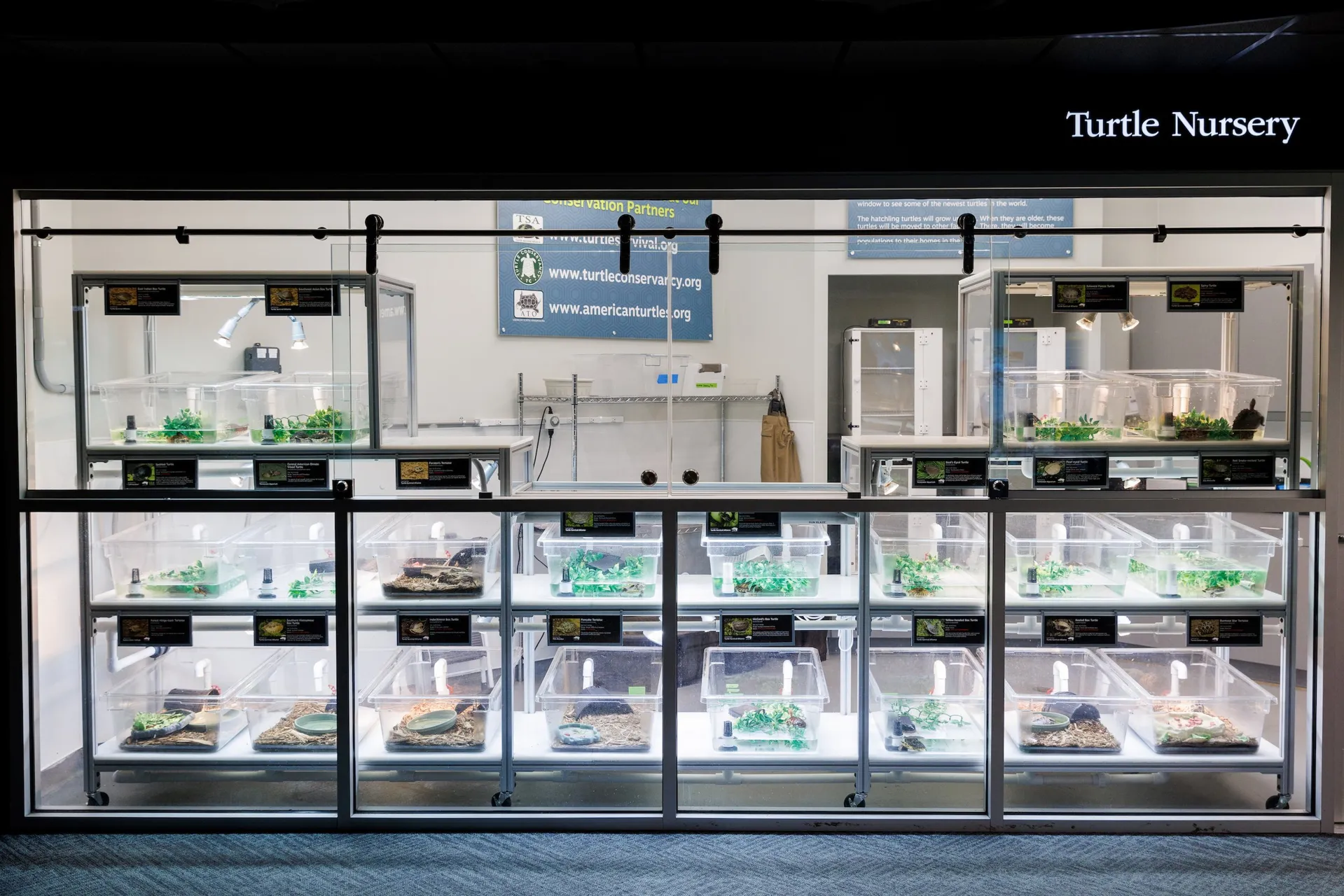
The Aquarium’s continued success breeding this incredibly imperiled Southeast Asian species has added 72 Four-eyed Turtles to the population in human care. Some of these have been sent to other zoological institutions accredited by The Association of Zoos and Aquariums, including the Bronx Zoo, Zoo Knoxville and Cameron Park Zoo in Waco, Texas. Many are on view in the Aquarium’s working Turtle Nursery in the River Journey building.
By the time Hughes arrived in 2004, the Aquarium already had a well-established reputation for freshwater turtle husbandry. Since opening in 1992, the Aquarium has hatched 1,166 turtles across 56 species and sub-species — an average rate of about 34 turtles a year.
Hatching turtle eggs is often a matter of carefully controlling parameters, such as substrate material, access to water, ambient heat and humidity. Especially for species that have no history of being raised in human care, determining the ideal conditions to hatch an egg can feel like a guessing game.
In some cases, herpetologists have learned to mimic environmental changes that occur in the wild.
To hatch the Hilaire’s Side-necked Turtle, Hughes had to act as a kind of “keeper of the seasons.” A native of South-Central South America, Hilaire’s Side-necked Turtles often lay eggs during that region’s cool, dry season when conditions would not be ideal for newly emerged hatchlings. To improve the odds of survival, eggs undergo a process of delayed development (aka “diapause”) until conditions improve.
Once they’ve developed, babies further delay their hatching (embryonic estivation) until environmental changes such as the arrival of rainy season storms and higher water levels signal that it’s safe to emerge.
To replicate this complex environmental arc, Hughes initially sets the eggs in an incubator at cooler temperatures and lower humidity before slowly warming them and eventually spritzing occasionally to mimic the arrival of “rain.”
“One signal makes them develop; another signal makes them go ‘Hey, it’s time to hatch,’” Hughes summarizes.
Hughes doesn’t keep these kinds of secrets to himself. Within the zoological community, specialists share knowledge between institutions to improve care for the species, as a whole.
“Information gets propagated. When I started the stud book for Spiny Turtles, it was not common for them to hatch in human care,” Hughes says, referencing an endangered Asian species whose shells are ringed by serrated plates (scutes).
“When we started working with them, most of the Spiny Turtles in the stud book were wild origin,” he adds. “Now, there’s a lot more Spiny Turtles around than there used to be, and it’s because we figured out how to hatch them.”
Measured against some years at the Aquarium, 2026 is actually — as Hughes described it — comparatively “slow.”
In 2020, the Aquarium gained national attention for successfully hatching five Four-eyed Turtles and two Beal’s Four-eyed Turtles (a closely related species). In 2024, the Aquarium made waves again by hatching a clutch of seven critically endangered Arakan Forest Turtles, a record within the Association of Zoos and Aquariums community.
Even if they’re not part of a record-setting year, however, every hatchling is important. In addition to contributing to “assurance populations” safeguarding against the possibility of extinction in the wild, they’re also vital in raising awareness of their species.
“People will see these hatchlings and go, ‘Oh, there’s a Four-eyed Turtle. I didn’t know there was such a thing,’ and then, ‘Oh, it’s critically endangered — that’s awful,’” Hughes says. “Once you see the baby, maybe you care more about the adult.”
The Tennessee Aquarium’s involvement in turtle care and protection extends to partnerships with other non-profits and state and federal wildlife management agencies. In 2020, the Aquarium founded — and remains a participant in — the Association of Zoos and Aquariums’ Saving Animals From Extinction (SAFE) American Turtles program, in which zoos and aquariums house and care for turtle species saved from wildlife trafficking by law enforcement.
To learn more about the Aquarium’s Turtles of the World gallery, visit tnaqua.org/exhibit/turtles-of-the-world/
Read more about the SAFE American Turtles program at tnaqua.org/at-the-aquarium/aza-safe-saving-turtles-together/