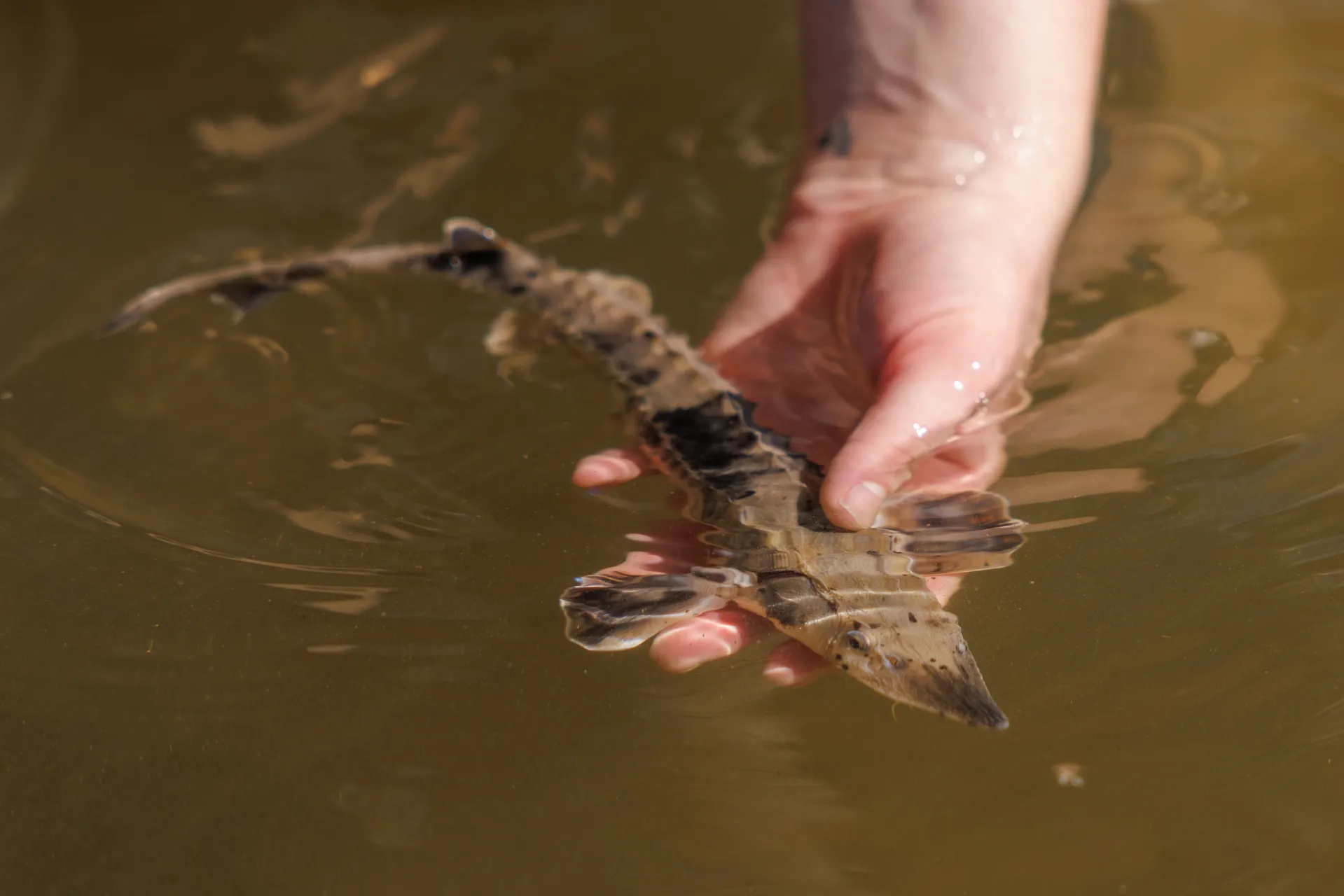
In almost stereotypically Southern fashion, a sudden summer squall nearly upended one of the defining moments of Ed Scott’s professional career on July 19, 2000.
A soft-spoken, enthusiastic fisheries biologist at the Tennessee Valley Authority, Scott had been dreaming of bringing Lake Sturgeon back to Tennessee since the late 1980s. The first concrete step in that process was poised to take place one muggy afternoon on a boat ramp leading into the French Broad River below Douglas Dam near Knoxville, Tennessee.
After years of discussion and planning, the first class of Lake Sturgeon — a species long absent from Tennessee’s waterways — had just arrived at the release site in the company of the Tennessee Aquarium biologists who helped raise them.
On the eve of that triumphant moment, however, the thunder was stealing Scott’s thunder.
“It was a hot day, and before we were ready to release the fish, there was a horrible storm,” he says. “There was very little shelter, so a lot of us were wet to begin with.”
Measuring only about the length of an adult hand, the sturgeon waiting for release already displayed the species’ most-distinctive features: a torpedo-shaped body; whisker-like barbels; rows of boney, spine-like scutes running along their flanks.
Still relatively small, they had the potential to one day reach eight feet long and weigh more than 300 pounds. Each one could live for more than 150 years.
The Lake Sturgeon is considered by scientists to be a “living fossil” and is one of the oldest fish in the fossil record for Tennessee. In their time on Earth, the species has survived countless historical hardships, from the calamity that wiped out the dinosaurs to the advance and retreat of glaciers.
By comparison, a rain delay barely qualified as an inconvenience.
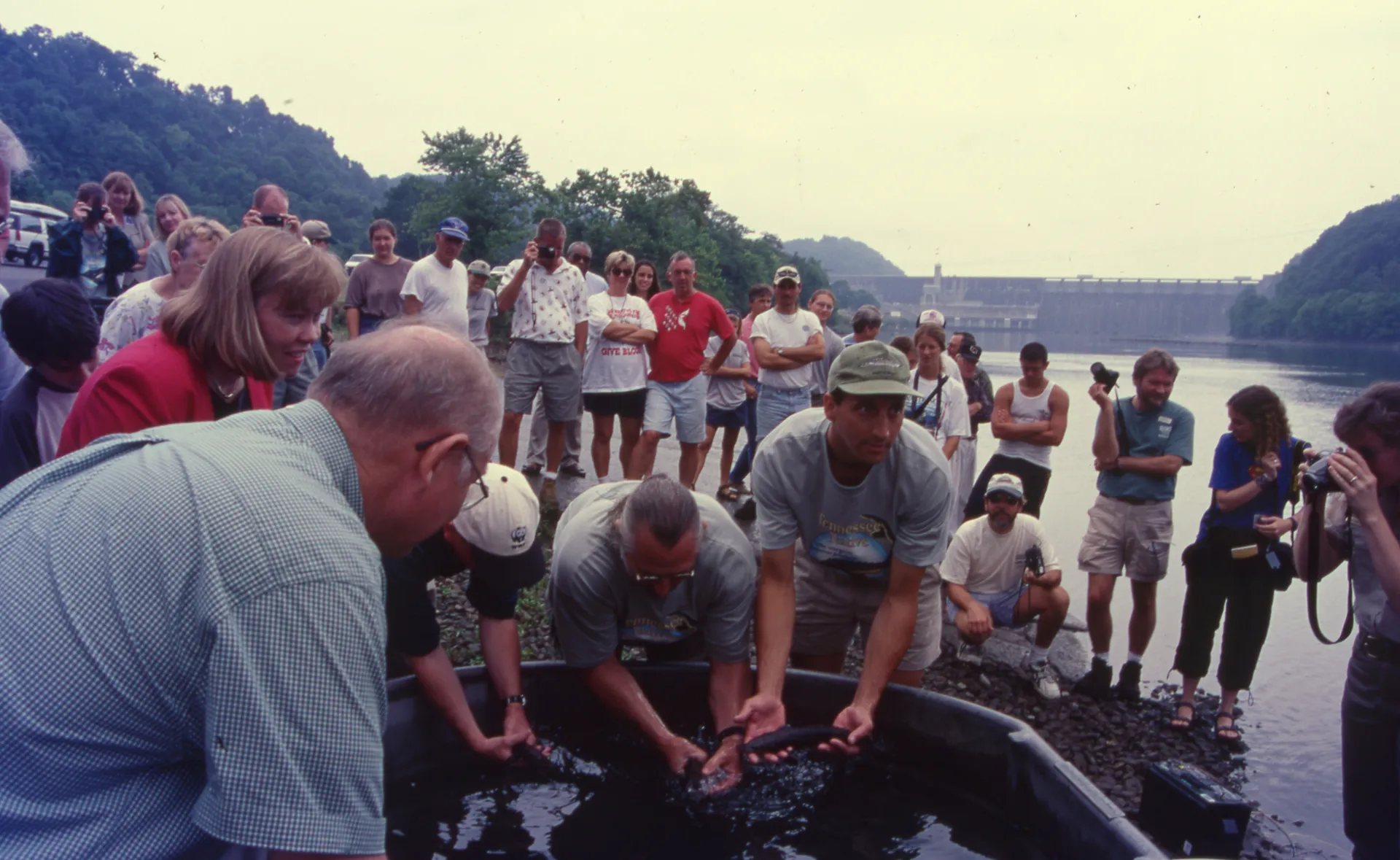
In typical summer fashion, the storm blew through, the skies cleared, and the long-awaited release proceeded as planned. Officials from the U.S. Fish and Wildlife Service and TVA gave speeches to a crowd of about 75 people before the sturgeon were gently eased into a waterway their ancestors first called home in the late Jurassic Period.
‘A Tennessee comeback’
The baby sturgeon released into the French Broad that day were the living end product of two years of collaboration between the Aquarium and other members of the Southeast Lake Sturgeon Working Group. A coalition of universities, non-profits and government agencies founded in 1998, the working group was united by a shared belief that the Lake Sturgeon was ripe to make a Tennessee comeback after a decades-long absence from the river due to pollution, damming and over-fishing.
Even knowing that the road ahead was a long and uncertain one, that first release felt like a significant step in the right direction, says Scott, who is now retired.
“Getting sturgeon back, as a fisheries biologist or a fisheries manager, is literally the biggest contribution we can make to the river and to the people of Tennessee,” he says. “It was wonderful [at that first release] to see the support that we had, the interest that there was in it, and this grand hope that one day there would be an abundance of Lake Sturgeon throughout the Tennessee River system.
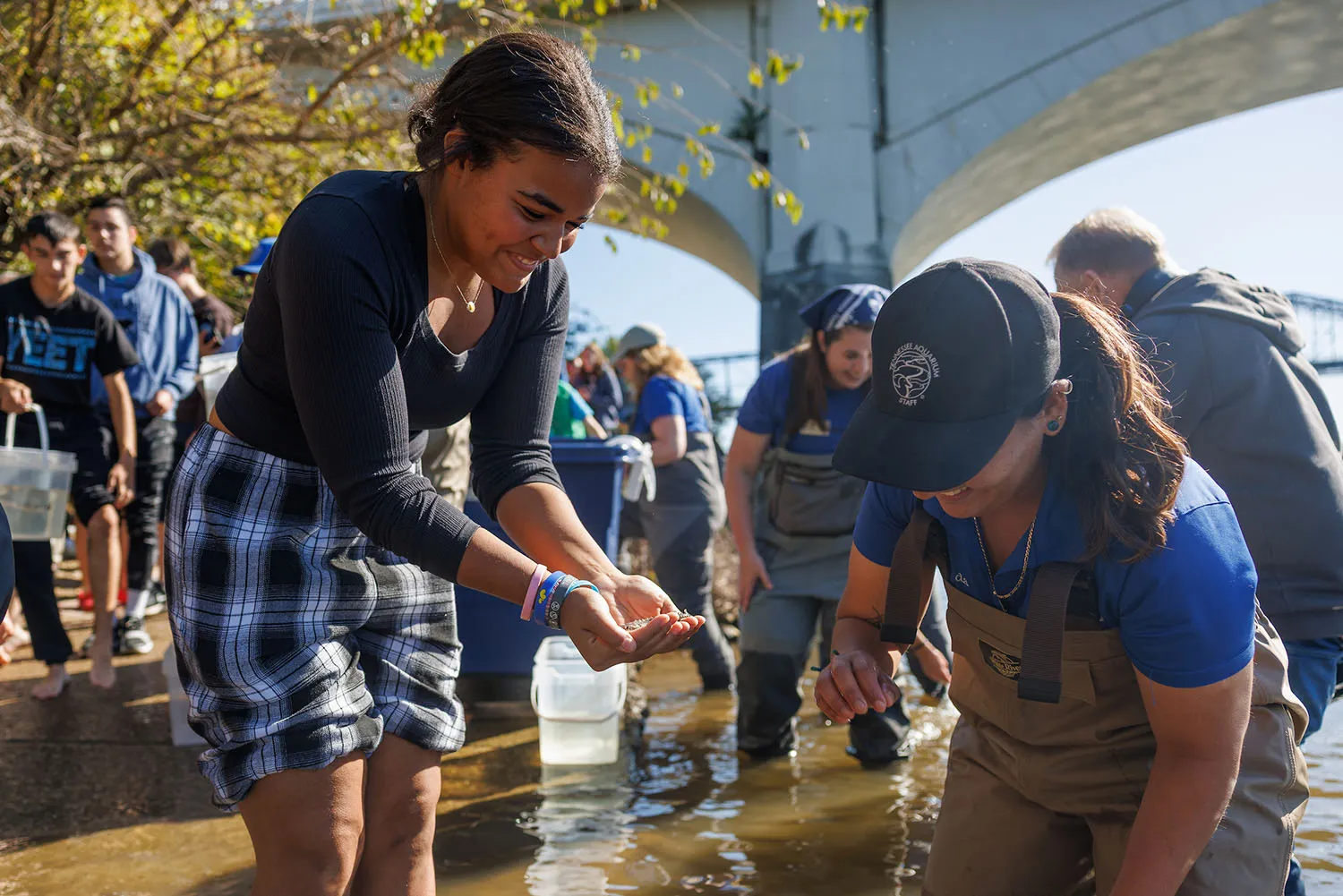
Lake Sturgeon releases circa 2000 and 2025
That grand hope persists.
Each spring for 25 years, biologists and wildlife managers have ventured to Wisconsin to collect eggs from wild spawning Lake Sturgeon. The fertilized eggs are sent to national fish hatcheries. Once they emerge, the young fish are sent to partnering propagation facilities like the Tennessee Aquarium Conservation Institute to grow larger. By the fall, they reach a releasable size (about six inches) and are returned to the river.
In October 2025, the program’s silver anniversary release took place — fittingly at another boat ramp — across the Tennessee River from the Aquarium’s home in downtown Chattanooga. There, about 500 fish were ferried to the water’s edge in clear plastic buckets by a group of invited officials, community leaders and other special guests, including dozens of students from Hixson High School.
That the program is still going after a quarter-century is unsurprising to the members of the Southeast Lake Sturgeon Working Group, none of whom entered into the process thinking it would be a quick-fix.
That awareness is rooted in the natural history of the Lake Sturgeon, which isn’t just long-lived but also slow to mature. Females don’t reach spawning age until they’re about 20 years old.
The fish reintroduced that fateful summer day in 2000 are now 25 years old and within the window for beginning to spawn on their own. That means the focus of this restoration effort is about to shift, says Dr. Anna George, the Aquarium’s vice president of conservation science and education.
“We’re here at this pivot point of the program,” Dr. George says. “It’s time to really step up our monitoring for wild reproduction.”

I’m optimistic that spawning is probably happening [in the Tennessee River], and we just haven’t detected it. I am so motivated to get out there.
Dr. Anna George
Vice President, Conservation Science & Education
Ready for ruckus
Recent reports and findings during routine monitoring efforts are giving biologists and wildlife managers hope that they might finally be able to pass the baton to Mother Nature.
With 430,000 Lake Sturgeon released across the Tennessee and Cumberland river watersheds in the last 25 years, the species’ conservation status in the state has recently been downgraded from “endangered” to “threatened.” This improvement is a hard-won victory that speaks to the long-term impact of the restoration effort, Dr. George says.
“I’m positive the downgrading is a result of the Southeast Lake Sturgeon Working Group’s effort,” she says.
Even better, the reintroduced population is now large enough, mature enough and genetically robust enough that spawning could begin any time. In fact, it may already be taking place, says Brandon Simcox, the rivers and streams coordinator for the Tennessee Wildlife Resources Agency.
“We’re seeing sexually mature fish now,” Simcox says. “We have mature males and females in Tennessee, so we have the recipe there that we should start to see natural reproduction.”
When it does begin happening in Tennessee, Lake Sturgeon spawning will be hard to ignore.
“It is a ruckus,” Dr. George says.
Each spring, Lake Sturgeon measuring five to seven feet in length migrate to spawning locations that generally feature jumbled stone bottoms known as riprap.
Once congregated, groups of sturgeon begin splashing energetically in the shallows along the banks of the river. Several males surround and thrum their tails along the sides of a lone female to encourage her to release tens of thousands of eggs. Once fertilized, these settle into sheltered cervices among the stones until they hatch.
That’s a lot of river
At 652 miles long, the Tennessee River is the largest tributary of the Ohio River, which is itself the largest tributary of the Mississippi River. According to data from the U.S. Geological Survey, the Tennessee River’s outflow is the seventh highest of any river in the United States.
That’s a lot of water to try to monitor for signs of breeding activity. In light of the size of the system, Dr. George and Simcox are near certain that Lake Sturgeon are already spawning in the Tennessee, but no one has a confirmed sighting of this activity yet.
 “I’m optimistic that it’s probably happening and we just haven’t detected it,” Dr. George says. “I am so motivated to get out there.”
As a state-endangered species, anglers are not allowed to target Lake Sturgeon, but they play an important role as on-the-water partners for agencies like TWRA. Anglers’ reports of incidental catches and their observations of sturgeon activity in the river offer vital population data to wildlife managers.
And some of the recent reports they’re sending in have agencies like TWRA brimming with hope.
“From some of those reports, we had started to hear about potential spawning,” Simcox says. “That has led us to learn a lot about what is going on out there.”
Fall and rise
For many younger Tennesseans, the absence of Lake Sturgeon has been a lifelong, gaping hole in their natural heritage, but historically, the species was so common in the river that they were seen as a nuisance.
In the past, commercial fishermen fed up by the damage caused to their nets by the sharp scutes on a Lake Sturgeon’s side would use them as fertilizer for crops or as food for hogs. The U.S. Fish and Wildlife Service reports the species’ numbers were once so plentiful that they were dried and burned as an oil-rich fuel source for locomotive and riverboat steam engines.
Eventually, the public came around on Lake Sturgeon, but that newfound popularity was a double-edged sword.
Tennessee’s commercial anglers began targeting Lake Sturgeon once it was discovered that their meat was tasty — especially smoked — and to satisfy demand for their eggs (also known as caviar), which came to be prized as a luxurious delicacy.
Over time, Lake Sturgeon numbers dwindled thanks to this unregulated harvest, in combination with the construction of dams that impeded their migratory and spawning behavior and waterways that were heavily polluted by rampant industrial discharge. Beginning in 1945, TVA kept a log of commercial landings of Lake Sturgeon in the lower three reservoirs of the Tennessee River. The last record of a wild Lake Sturgeon caught in the river was 1963.
“It was almost a perfect fishing collapse,” Dr. George says. “Catches were going higher and higher, and then all of a sudden, they were gone.”
It took decades and a series of legislative acts and changes to river management to set the stage for the Lake Sturgeon’s return.
The Lake Sturgeon became protected as a state-endangered species with the passage of the Tennessee Nongame and Endangered or Threatened Wildlife Species Conservation Act of 1974. This act also established TWRA, which is responsible for managing the species throughout the state.
Conditions in the river slowly began to recover thanks to the passage of the Clean Water Act of 1972 and TVA’s Reservoir Release Improvement Program in the early 1990s. These improved water quality in the Tennessee River and ensured the water flow from dams was consistent and properly oxygenated, two parameters that are key to the survival of newly hatched sturgeon.
“It was my job to see if the improved water quality [from the Reservoir Release Improvement Program] affected the fish communities downstream,” Scott says. “It was very noticeable.
“Fish species that had been missing before started reappearing, and we thought, ‘Oh, my gosh. Well, what else could we have? We could probably have Lake Sturgeon again.’ That’s where the idea started.”

A roadmap for the future
Raising and releasing Lake Sturgeon is only one facet of the restoration effort. It’s also important to encourage public support for the species by inviting community members to actually put fish back in the river whenever possible.
“Sturgeon releases are really, really exciting days,” Dr. George says. “One of the joys of working at the Tennessee Aquarium is we get to invite a lot of the public to come with us.”
By involving the public in releases such as the 25th anniversary release in downtown Chattanooga, the community forges meaningful connections to a species that likely disappeared from Tennessee waters before many of those who are participating were even born, Simcox says.
“Some of the education that goes on during the releases is telling folks, ‘You’re releasing this fish, and it’s going to be in the system for 100 years,’” he says. “That gives them a long-term connection to those fish that they’re putting out into the river — the thought that they’re going to be there for generations.”
As the working group trains its collective eyes on the river for signs of wild reproduction, the arrival of that long-awaited activity will signal more than the success of an effort that began 25 years ago; it will help fill out a roadmap to even more future success stories, Dr. George says.
“Once the Lake Sturgeon is self-sustaining in Tennessee and we have an appropriately managed recreational fishery, we’ll have this recipe for success that we can apply to other animals that we might have lost through carelessness,” she says. “That’s what’s really so great to me about the Lake Sturgeon.
“It’s not just about the fish; it’s about everything.”